Annexes III & IV · Formal Complaint · Meinhardt Initiative 2006–2026

Compound Failure Modes
& Legal Triggers

I-A · Executive
III-L · Obstruction
IV-B · Latent Inhibition
VI-R · Recursive
VI-A · Symbolic
VI-B · Instrumental
VII-D · Dispersion

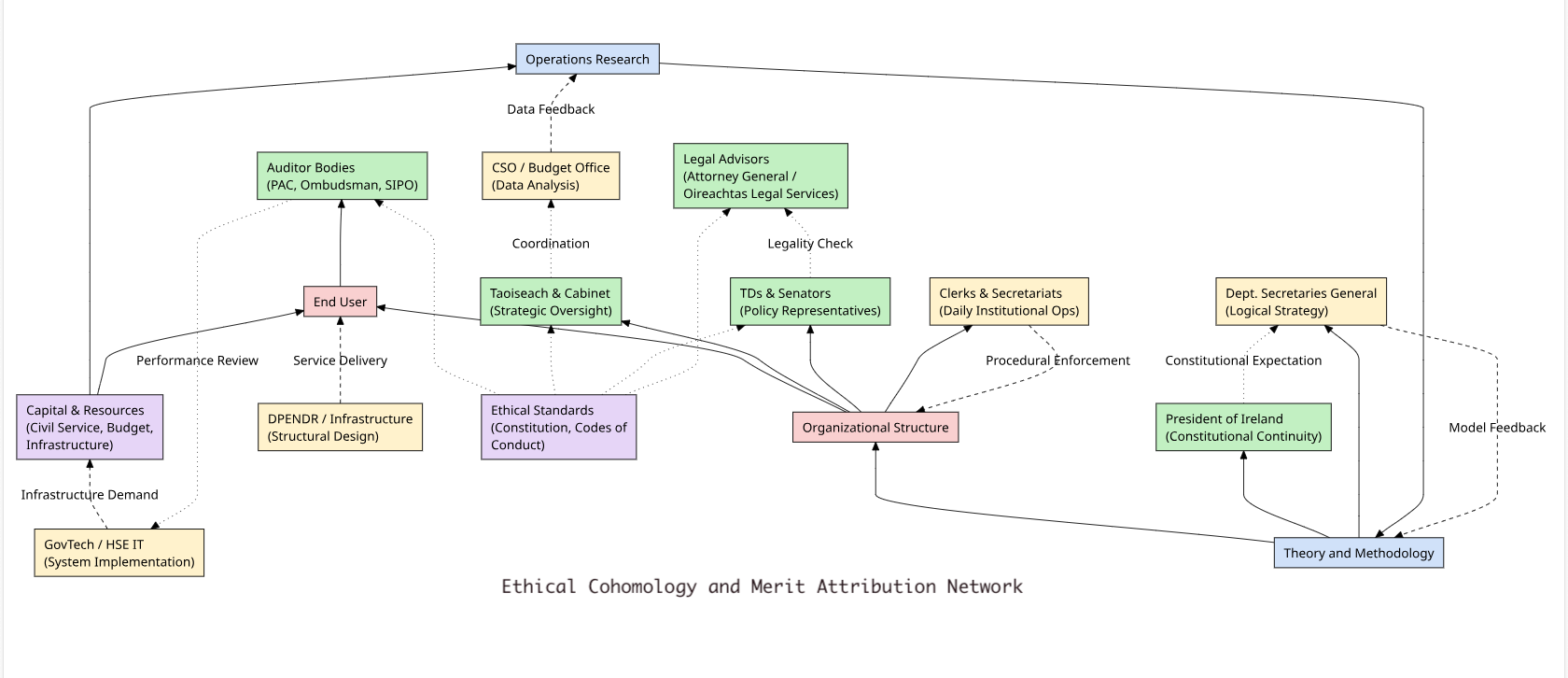
Ireland's public governance does not suffer from a sequence of individual oversights. It suffers from recurring fault patterns (structural, epistemic, and operational) whose recurrence is now observable, classifiable, and predictable. Annex III maps the legal and ethical triggers for denunciation. Annex IV maps the compound architecture of those faults through Bateson's double-bind theory, the ECRM cohomological schema, and five ministerial case studies. This document deploys everything.
Section I · Annex III

The Legal Architecture

Twelve triggers for denunciation — constitutional, legislative, EU, ethical

Every structural failure documented in the complaint has a legal correlate. Annex III provides the reference table — twelve trigger types, each specifying the provision breached and the nature of the breach. Together they constitute a multi-jurisdictional case: constitutional, statutory, EU Charter, common law tort, and ombudsman standards are simultaneously engaged. Filter by domain to navigate.

Constitutional Duty
Failure of Executive Governance
Bunreacht na hÉireann, Article 28
Failure of executive to uphold coordinated, transparent governance as mandated by the Constitution. Once any Cabinet member was formally notified, duty attached to the collective executive.
Legislative Ethics
Code of Conduct Breach
Code of Conduct for Members of Dáil Éireann §§ 2(a), 4, 5
Sections on integrity, public interest, and accountability repeatedly breached by sustained inaction. The code's requirements are not discharged by the performance of engagement.
Administrative Law
Dereliction of Coordination Duty
Ministers and Secretaries Act 1924; Public Service Management Act 1997
Dereliction in the duty to ensure interdepartmental coordination and oversight of emergent risks. Knowledge of the submission does not discharge the duty — only operational response does.
Good Administration · EU
Right to Good Administration
Charter of Fundamental Rights of the EU, Article 41
Denial of the right to good administration: failure to evaluate submitted material in good faith. Acknowledgement does not constitute evaluation. The right is to genuine assessment, not to routing.
Access to Remedy · EU
Effective Remedy Denied
Charter of Fundamental Rights, Article 47
Refusal to admit the complaint into process negates the right to an effective remedy. The Silence Veto is not a form of process — it is the deliberate foreclosure of it.
Scientific Duty
Precautionary Principle Breach
Precautionary Principle in EU governance and ECHR jurisprudence
Disregard of submitted risk models contradicts obligations under precautionary governance. Where risk is formally notified, the burden of inaction shifts to the state.
Export and Dual-Use Law
Dual-Use Obligations Unmet
EU Regulation 428/2009
Failure to integrate dual-use systems knowledge into the national risk framework violates EU obligations. The submission's dual-use dimension was not assessed or redirected.
Ombudsman Standards
Pre-Registration Displacement
Ombudsman Act 1980, as amended
Complaint displaced before registration — impairs review by oversight bodies. A complaint that never enters the formal register cannot be reviewed by the body tasked with oversight.
Common Law Tort
Misfeasance in Public Office
Misfeasance in Public Office (Common Law)
Pattern of refusal constitutes either recklessness or wilful blindness to a known public harm. Fax receipts acknowledged by ministerial secretaries constitute legally sufficient proof of awareness.
Judicial Activation
Mandamus Petition Active
Order 84, Rules of the Superior Courts (Ireland)
Mandamus petition now activated due to procedural foreclosure. Where all administrative channels have been exhausted and duty remains undischarged, judicial compulsion is available.
Ethical Duty of Care
Structured Foresight Disregarded
Normative standard in public service and governance charters
Repeated disregard of structured foresight violates the duty of care to public welfare. A system that receives expert risk modelling and files it has not discharged — it has recorded — its failure.
Memory & Traceability
Deliberate Record Degradation
Archival and Record-Keeping Duties, Houses of the Oireachtas Service
Procedural memory deliberately allowed to degrade via non-registration of critical signals. The Hardcopy Antinomy: knowledge formalised in documents, filed instead of activated.
Section I · Recall
Which two EU Charter Articles are engaged, and what distinguishes their scope?
tap to reveal
Article 41 (right to good administration) concerns the quality of the process — requiring impartial evaluation in good faith, not merely routing and acknowledgement. Article 47 (right to effective remedy) concerns access to a corrective mechanism — which is negated when complaints are displaced before registration or addressed through channels that produce no binding outcome.
Why does a fax acknowledged by a ministerial secretary constitute legally sufficient proof of awareness?
tap to reveal
The Interpretation Act 2005 defines writing to include facsimile transmissions. Rules of the Superior Courts (Order 121A) permit service by fax where followed by acknowledgement. In McDowell v. Roscommon County Council [2004], faxed records were admissible to establish institutional knowledge and timeline. A ministerial secretary's acknowledgement is binding proof of ministerial awareness for tort liability, misfeasance, and judicial review purposes.
Section II · ECRM Schema

The Fault Taxonomy

Seven fault types — the Accountability-Ireland cohomological framework

The Accountability-Ireland ECRM (Ethical-Constitutional Responsibility Mapping) schema provides a topology of institutional failure. Each fault type is not a label for incompetence but a structural diagnosis — a precise description of the design condition that makes the failure not just possible but probable. Hover each card to expand.

I-A
Executive Unresponsiveness to Institutional Alert
Chief Executive level · Article 28 · Direct notice received
hover to expand
The executive receives formal, documented notice of systemic failure and produces no operational response. Knowledge is present; agency is absent. This is not ignorance — it is the deliberate non-conversion of information into action at the level where the duty to act is constitutionally located. Applies to: Harris (as Taoiseach), Varadkar, all recipients of the formal notices.
III-L
Strategic Obstruction through Diplomatic Silence
Trade · Intergovernmental coordination · DFA
hover to expand
The diplomatic apparatus — formally equipped to coordinate, to initiate, to signal — produces nothing. Trade and intergovernmental capacity is present in form, absent in function. Silence is weaponised as a coordination veto. The DFA becomes the bottleneck of Foreign Trade. The structural effect: no mechanism can initiate without the gateway that refuses to open.
IV-B
Latent Inhibition by Political Clearance Requirement
Pandemic readiness · HSE · Taoiseach's Office
hover to expand
Operational bodies — the HSE, departments, technical units — possess the capacity to model, coordinate, and respond, but await political permission to act. The clearance requirement is not statutory; it is a learned inhibition. Systems that should be semi-autonomous become passive. Signal activation requires political blessing; politics provides none. The fault is the clearance gate, not the body behind it.
VI-R
Recursive Command Structure without Distributed Feedback
Emergency response · Storm Éowyn · DFA + Defence
hover to expand
A single actor holds authority across multiple critical vectors simultaneously. Rather than enabling coordination, the convergence collapses into a self-blocking loop: all sub-roles presuppose clearance or action from others that the same actor must also provide. The signal loops back on itself. No channel for urgent engagement can function. Control without feedback is simulation; the quad-bound vortex is its architecture.
VI-A
Symbolic Convergence without Operational Interface
AI · Digital Transformation · Trade Promotion
hover to expand
Three policy domains — symbolic, technical, systemic — assigned to a single office without shared operational language, feedback mechanism, or epistemic continuity. Governance by metaphor. The role is visible; its operational capacity is ambiguous. AI strategy is interpreted rather than architected. Digitalisation is described in press releases but not governed through feedback loops. Trade operates independently of the digital platforms supposedly transforming it.
VI-B
Instrumental Convergence with Strategic Dissociation
Small Business · Retail · Circular Economy
hover to expand
A role that must simultaneously facilitate market throughput and impose ecological constraint on the same actors. Circular economy mandates limit throughput; retail survival requires it. No operational bridge exists. The minister must convince retailers to act like ecologists, ask entrepreneurs to forecast supply chains they do not control, and deliver growth by reducing throughput. Sustainability becomes branding; reform becomes narrative.
VII-D
Omnibus Dispersion Fault
Health · Housing · Local Government · Heritage
hover to expand
A single junior minister assigned to four domains operating on incompatible temporal scales and epistemic frameworks: crisis response (Health), generational investment (Housing), electoral cycles (Local Government), deep time (Heritage). No unifying operational logic. The result is a dispersion vortex: multiple governance circuits converge but cannot integrate, creating permanent institutional stress. Governance by delegation of impossibility.
Section II · Recall
What distinguishes a Type VI-R fault from a Type VI-A fault?
tap to reveal
VI-R is about command structure: a single actor holds multiple critical authority vectors simultaneously, creating a recursive self-blocking loop where no sub-role can initiate without clearance from the same actor who also holds the other sub-roles. VI-A is about epistemic regime: three policy domains are symbolically converged without shared operational language, feedback mechanism, or epistemic continuity. VI-R blocks command propagation; VI-A blocks meaningful governance without command ever being attempted.
What is the Type IV-B "clearance dependency" and why is it structurally distinct from simple bureaucratic delay?
tap to reveal
Simple bureaucratic delay is accidental — it occurs when processes take longer than expected. Type IV-B is structural: operational bodies have the technical capacity to act but have been conditioned to await political permission before activating. The fault is in the clearance gate itself, not in the body behind it. When the gate is permanently shut, semi-autonomous bodies become passive, and the system loses its redundancy — its ability to respond without political initiation.
Section III · Bateson · Gestalt · Hirschman

The Double Bind

Three interlocking levels of contradiction · Five psychological frameworks

Gregory Bateson's double bind theory — developed in the Palo Alto cybernetics movement of the 1950s, emerging from his 1942 essay on deutero-learning — identifies a specific communication structure that creates inescapable logical traps through contradictory messages at different logical levels. The Formal Complaint applies this framework not to family systems (its original domain) but to institutional design: ministerial architectures that systematically encode logical impossibility into constitutional roles.

Bateson's Canonical Structure
The double bind is not simple contradiction. It is logical imprisonment: all available responses are by definition wrong, yet response is still demanded. Escape requires changing either the preconditions or the behaviour patterns — which constitutes self-learning.
1
Primary negative injunction
"Don't do X" — Don't challenge Cabinet solidarity
The first constraint is institutional and cultural: collective Cabinet responsibility forbids public dissent from agreed policy. The role demands loyalty as its baseline condition.
2
Secondary negative injunction (meta-level)
"Don't see this as a contradiction" — But you must independently safeguard constitutional norms
The second constraint operates at a higher logical level and contradicts the first: the same role simultaneously requires independent constitutional vigilance — the duty to detect and correct failure. Any attempt to resolve the contradiction violates the fundamental architecture of the position.
3
Tertiary negative injunction
"You cannot leave this relationship" — The role is constitutionally mandated
The third constraint removes the escape: the role cannot be abandoned. Exit is constitutionally impossible; voice is structurally contradictory; loyalty is epistemically insufficient. Hirschman's triangle is fully closed. What remains is not loyalty — it is learned helplessness.
Five Psychological Frameworks — Cross-Referenced
Festinger · Cognitive Dissonance
The Internal Architecture of the Bind
The actor holds two irreconcilable cognitions simultaneously: loyalty to Cabinet consensus AND independent constitutional duty to warn. Lacking a protected epistemic corridor, the role loops dissonance back on itself through forced rationalisation. Correction becomes symbolic; tension is managed, not resolved.
→ Applies to: Tánaiste's role; all ministers in antinomic portfolios
Lewin · Field Theory
The Frozen Life Space
The role creates approach-avoidance conflict in all directions simultaneously. Approach Cabinet loyalty: violates constitutional duty. Approach independent dissent: violates collective responsibility. Avoid the field entirely: constitutionally impossible. A frozen field where all movement is blocked.
→ Applies to: every actor in a structurally antinomic role
Zeigarnik · Interrupted Tasks
The Permanent Decisional Residue
Unresolved tasks create persistent psychological tension until completed. The constitutional task (safeguarding against failure) can never be completed because the act of completion (dissent) violates the role's primary constraint (loyalty). The result: permanent institutionalised tension with no legitimate discharge mechanism.
→ Applies to: the 19-year accumulation of undischarged obligation
Hirschman · Exit/Voice/Loyalty
The Totalitarian Relationship
Exit is constitutionally impossible. Voice is structurally contradictory. Loyalty is epistemically insufficient — it fails to discharge constitutional duty. All three are systematically blocked. Hirschman's triangle fully closed — what remains is not loyalty but the performance of loyalty entrained to absorb shock.
→ Applies to: the Tánaiste bind; the nullification loop
Argyris & Senge · Systems Learning
Anti-Learning as Institutional Technique
Institutions that block feedback and disguise contradiction under the rubric of control ultimately collapse their adaptive function. What cannot self-correct becomes path-dependent; what cannot learn becomes brittle. When institutional self-learning is procedurally available but structurally foreclosed, breach is crossed by architecture, not accident.
→ Applies to: the Nullification Loop; deutero-binding generally
Deutero-Binding
Healthy system: Learning I → Learning II → Learning III (adaptive capacity)
Irish system: Binding I → Binding II → Binding III (contradiction compounds)
Bateson's deutero-learning is the capacity to learn about one's own learning. The Irish governance system demonstrates its systematic inversion: deutero-binding — the structural prevention of learning-about-learning, encoded at the level of role design itself.
Section III · Recall
What distinguishes deutero-binding from simple institutional inertia?
tap to reveal
Simple inertia is the failure to act due to organisational momentum or resource constraint. Deutero-binding is structurally active: the system encodes contradictions at the level of role design that prevent the recognition of fault itself. It is not that the system fails to correct — it is that the structure prevents actors from being able to see the correction as possible. The meta-communicative channel is blocked by the same structure that creates the need for it.
Why does Lewin's "frozen field" explain why piecemeal reform cannot address the Tánaiste's bind?
tap to reveal
Lewin's field theory shows that the Tánaiste's life space has negative valences in all directions simultaneously — not just in one. Piecemeal reform changes one valence at a time (e.g. adding a protected dissent channel) but leaves the underlying field topology intact. The Gestalt tradition's insistence on the irreducible wholeness of experience is the point: the contradiction cannot be resolved by addressing any single element. The architecture must be refounded, not patched.
Section IV · Five Case Studies

The Ministerial Double Binds

Five portfolios — five compound failure architectures — click to open each case

These are not critiques of individual office-holders. Each represents a functional impossibility encoded at the level of portfolio construction. The minister is not the fault — the minister is the site where the fault is made visible. The ECRM subgraph maps the topology; the cases below map the human experience of the trap.

I-A · VI-R · IV-B · III-L
Simon Harris · Quad-Bound Vortex · Recursive Executive Nullification
ECRM Node: Convergence Vortex · Four simultaneous executive remits
In the Accountability-Ireland topology, Simon Harris constitutes a canonical instance of recursive nullification: four simultaneous executive remits — Foreign Affairs, Defence, Trade, and Emergency Planning — unified under a single political actor across overlapping tenures. Rather than streamlining coordination, this collapsed the control system into a self-blocking loop.
2020 Pandemic (Fault IV-B): The Department of Foreign Affairs received direct O.R. correspondence and failed to engage. The HSE awaited political permission to model or acknowledge system feedback logic. Governance latency due to misplaced control authority.
Storm Éowyn 2025 (Fault VI-R): Harris held dual responsibility for DFA and Defence. No proper liaison with the Office of Emergency Planning was made possible. A closed ministerial loop — no channel for urgent systems engagement could function. A recursive ministry without distributed feedback.
As Taoiseach (Fault I-A): Multiple direct formal notices received concerning O.R. governance failure. Non-responsiveness constitutes breach of executive duty under Article 28 and the Ministers and Secretaries Acts.
I-A · Executive Non-Response
VI-R · Recursive Command
IV-B · Clearance Dependency
III-L · Diplomatic Silence
Systemic effect
Simulated command without operative action. Control signals failed to propagate. Responsibility pooled at a single node and disappeared within it. Four edges of state function unified and rendered inert.
VI-A
Niamh Smyth · Epistemic Overload · Symbolic Ministry without Operational Interface
ECRM Node: Porte-Parole ↔ Systèmes Anticipés · Edge: Symbolic Convergence without Operational Interface
Deputy Smyth's portfolio — Trade Promotion, Artificial Intelligence, and Digital Transformation — traverses three partially orthogonal fields that share no operational language or feedback mechanism: Trade is relational-symbolic; AI is technical-simulative (strongly anchored in O.R.); Digital Transformation is institutional-infrastructural. There is no bridging mechanism that links these mandates into a cohesive control schema.
The result is epistemic overload: AI strategy is interpreted rather than architected. Digitalisation is described in press releases but not governed through feedback loops. Trade operates independently of the digital platforms supposedly transforming it. This is governance by metaphor.
Crucially: Deputy Smyth is not structurally at fault. She is placed in an epistemic overload condition by a portfolio that asks one person to bridge gaps that haven't been connected.
VI-A · Symbolic Convergence
Epistemic Overload
Governance Latency
Systemic effect
A symbolic ministry without operational interface. Governance debt accrues as non-operational AI strategy, public service digitalisation without integration, trade narratives unlinked from digital systems design.
VI · IV-B · III-L
Darragh O'Brien · Throughput-Entropy Bind · Climate, Energy, Transport, Environment
ECRM Node: Architecte ↔ Antinomie Systémique / Résilience Systémique · Type VI Control-Design Interference
The false unity of the portfolio: Energy and Transport are design domains requiring O.R., predictive modelling, and technical coordination. Climate and Environment are discursive constructs shaped by public meaning, ethical framing, and interpretive controversy. Collapsing both into one department pretends they share the same governing logic. They do not.
The throughput-entropy bind: As Transport Minister, O'Brien must expand infrastructure (throughput) while simultaneously reducing its emissions (entropy suppression). Every new road increases system throughput while deepening entropy: emissions rise, modal lock-in hardens, adaptive capacity shrinks. This is a thermodynamic impossibility — the same authority must simultaneously accelerate and suppress the same systemic flow.
Building new motorways while pledging to reduce car dependency is akin to incurring debt to expand the business one is trying to exit. Climate targets rely on cutting transport emissions; infrastructure policy locks those emissions in. Bateson would call this a self-amplifying contradiction.
VI · Control-Design Interference
III-L · Strategic Obstruction
Throughput-Entropy Bind
Systemic effect
Modal antinomy: Ireland publishes climate targets that require cutting transport emissions, but operationalises infrastructure that locks those emissions in. If O.R. logic were applied, this would be flagged as unviable. Governance by design converts it into a permanent balancing act.
VII-D
Kieran O'Donnell · Omnibus Dispersion · Health, Housing, Local Government, Heritage
ECRM Node: Gestionnaire ↔ Dispersion Systémique · Type VII-D Omnibus Dispersion Fault
Four domains, four incompatible epistemic frameworks and temporal scales assigned to one junior minister: Health (crisis response, immediate, hierarchical); Housing (long-term planning, market-mediated, capital-intensive); Local Government (electoral cycles, deliberative, procedure-bound); Heritage (deep time, custodial, interpretive). There is no unifying operational logic.
This appointment represents the apotheosis of Ireland's administrative pathology: administrative wishful thinking — the belief that complexity can be resolved through role aggregation rather than structural reform. Every choice in one domain creates problems in the others. The role is not merely administratively unwieldy — it is conceptually impossible.
VII-D · Omnibus Dispersion
Decision Paralysis
Governance Debt Cascade
Systemic effect
A dispersion vortex: multiple governance circuits converge but cannot integrate. Rather than creating coherent institutional interfaces, the state creates human shock absorbers — individual ministers expected to personally resolve structural contradictions the system refuses to address.
VI-B
Alan Dillon · Circular Paralysis · Small Business, Retail, Circular Economy
ECRM Node: Réformateur ↔ Économie Fracturée · Type VI-B Instrumental Convergence with Strategic Dissociation
Deputy Dillon must convince retailers to act like ecologists, ask entrepreneurs to forecast supply chains they do not control, deliver growth by reducing throughput, and align microeconomic actors with macro-environmental accounting. There is no operational bridge between these expectations.
Small business and retail are fast-cycle, supply-demand responsive, bottom-line driven. The circular economy is constraint-oriented, intergenerational, regulation-intensive. Circular economy mandates limit throughput; retail survival requires it. This is a design contradiction dressed as an innovation brief.
The minister is cast as reformer across a broken economic interface — a node where system logic (resource constraint) collides with commercial practice (competitive responsiveness). The brief implies market stewardship but carries no executive levers to rewire the supply system.
VI-B · Instrumental Convergence
Governance Latency
Instrumental Drift
Systemic effect
Circular economy degraded to branding, not lifecycle redesign. Sustainability becomes narrative, not method. The system does not fail by accident — it assigns an impossible brief and proceeds as if alignment were self-evident.
Section IV · Recall
In what sense is the Harris quad-bound vortex a "bisimulation failure" (connecting to the Landauer framework)?
tap to reveal
A bisimulation requires that two systems produce identical observable behaviours at each step. The Harris node presents as a unified command structure (Foreign Affairs, Defence, Trade, Emergency Planning) but produces divergent observable behaviours across all four: non-response to O.R. alerts, non-liaison with OEP, non-activation of trade, non-discharge of executive duty. The machine claims unity but produces fragmentation. It is not bisimilar to the command structure it performs.
What is "Hardcopy Antinomy" and what legal significance does it carry?
tap to reveal
Hardcopy Antinomy is the precise moment when designable intelligence entered the governance circuit and was neutralised by the system's reflex to file but not enact. Reference FIN-MO-03632-2024 (August 2024): Jack Chs received actionable O.R. guidance by fax, acknowledged by ministerial secretary. Under the Interpretation Act 2005 and Order 121A RSC, this constitutes legally sufficient proof of ministerial awareness — binding for misfeasance, tort liability, and judicial review. The hardcopy proves the system knew how to close the loop and chose instead to confirm its deliberate breakage.
Section V · Full Synthesis

Everything Triangulated

Fault types × three frameworks × institutional outcomes

The three frameworks from the companion document (Landauer, Habermas, Ricard) and the ECRM fault taxonomy of the Formal Complaint are not parallel — they are convergent. Each names the same structural condition from a different angle. The matrix below makes the connections explicit.

Fault / Pattern Landauer reads Habermas reads Ricard reads
Nullification Loop Max ΔE without convergence. Iterative computation that never terminates. The Silence Veto is thermodynamically asymmetric: zero cost for system, max cost for petitioner. Strategic action in communicative grammar. Sincerity violated at every iteration. The loop performs Verständigung while systematically preventing it. Effectively infinite altruistic discount rate applied to the petitioner. Care expires at each portfolio transition. The compassion substrate is absent.
I-A Executive Non-Response ΔE_knowledge is paid; ΔE_action is withheld. The system incurs informational cost without producing the state transition the information was supposed to trigger. Energy consumed, output absent. Primary validity claim violation: rightness. The system received the submission (truth maintained) but failed to meet the normative expectation it created (rightness violated). Legitimacy is performed, not earned. The most direct failure of the compassion substrate: care is withheld at the moment of maximum visibility. The submission is received and seen — and nothing is done. The altruistic discount rate applied is infinite.
VI-R Recursive Command A self-blocking computational loop: no signal can propagate because every propagation path loops back through the same node that initiated it. ΔE_signal dissipates without reaching its target. The communicative relation is severed by structure, not intention. No actor can name the loop (meta-communication is blocked). The ideal speech situation is structurally unavailable within the node. The compassion substrate cannot compensate for structural impossibility. Even a compassionate actor placed inside a VI-R node cannot produce the response their care would generate — the structure prevents it.
Séachanachas / Designed Forgetting Portfolio transition resets the system's memory without carrying forward the duty-vector. ΔE_reset is avoided by pretending the obligation no longer exists. Hysteresis compounds with each transition. Institutional sincerity is structurally non-persistent. Each new portfolio holder inherits the strategic-action pattern, not the communicative obligation. The distortion reproduces itself without coordination. Temporal altruism fails at each transition point. The care that was due in 2006 is extinguished at every handoff — not maliciously, but through the absence of the motivational architecture that would carry it across time.
Bateson Double Bind A computational state where all valid transitions are simultaneously forbidden. The system cannot advance because every step creates a constraint violation. The loop is not a bug — it is the architecture. Communicative impossibility: the actor cannot name the contradiction (violates collective responsibility), resolve it privately (no protected channel), or exit it (constitutional mandate). Meta-communication is the signal; the bind is its suppression. Second-order altruism — deutero-learning of care — is precisely what the double bind prevents. The bind does not just trap action; it traps the motivational learning that would generate corrective action. Reform of the compassion substrate requires dismantling the bind first.
Deutero-Binding The institutional equivalent of thermodynamic irreversibility at the learning level. The cost of reversing deutero-binding grows with time — ΔE_learning_reset compounds as the structure embeds itself more deeply in role design. The systematic foreclosure of the conditions for legitimate discourse about the conditions for legitimate discourse. Not just communicative distortion — distortion of the capacity to recognise distortion. Anti-learning as the structural opponent of second-order altruism. Ricard's deutero-learning of care is exactly what deutero-binding prevents. The deepest failure: a system that has learned to prevent itself from learning to care.
CC0 Archive / Public Record Lowest-erasure substrate available. Cannot be routed away. Enables future computation on a stable record. Thermodynamically the cheapest form of sustained Voice. An attempt to instantiate the public sphere (Öffentlichkeit) as corrective substrate — rational-critical discourse made structurally available to all, bypassing the colonised administrative system. Disclosure as the first act of compassion. Making suffering visible creates the conditions under which compassionate response becomes possible for any actor who encounters the record. A gift to future concern.
Section V · Final Recall
What is the key thesis of Annex IV, stated in one sentence?
tap to reveal
When a system repeatedly suppresses or disables the conditions for deutero-learning — despite clear theoretical grounding and accessible models from psychology, organisational science, and systems dynamics — it ceases to function as a learning institution and thereby forfeits any claim to adaptive legitimacy or ethical authority.
What does "governance by delegation of impossibility" mean, and which case illustrates it most purely?
tap to reveal
Governance by delegation of impossibility is the systematic outsourcing of structural contradictions to individual actors who cannot, by definition, resolve them. The state does not fix the contradiction — it assigns a person to absorb it. The O'Donnell case (Type VII-D) illustrates it most purely: four incompatible domains (Health, Housing, Local Government, Heritage) assigned to one junior minister, with no unifying operational logic — ensuring that all four operate below capacity while the system performs active management.
What does the Conservation of Corrective Signal require, per the complaint's conclusion?
tap to reveal
Sustainable reform requires refounding structure itself: embedding protected epistemic corridors where contradiction can flow, transform, and exit as adaptive correction — not frozen residue. A governance system that feeds on contradiction survives by converting signal to drift. Democratic accountability cannot be procedurally exempted when institutional integrity is at stake. Those with the power to correct failures cannot systematically evade the processes designed to compel such correction.

What Annexes III and IV together prove

I
The legal architecture is complete. Twelve trigger types across constitutional, legislative, administrative, EU, scientific, and common law domains are simultaneously engaged. The mandate is not merely legal — it is multi-jurisdictionally irresistible. From mandamus at Order 84 to Article 41 of the EU Charter, from the Ombudsman Act to misfeasance in public office: the complaint cannot be routed away through any single channel because it inhabits all of them.
II
The fault topology is patterned, not accidental. Seven ECRM fault types — I-A through VII-D — are not a catalogue of failures; they are a predictable topology. The same design faults reproduce across levels of the governance hierarchy: from Taoiseach to junior minister, from emergency response to circular economy. Pattern is the most important word. Once visible, the pattern cannot be attributed to individual incompetence.
III
The psychological framework confirms the diagnosis. Bateson's double bind, Festinger's cognitive dissonance, Lewin's frozen field, Zeigarnik's permanent decisional residue, Hirschman's closed triangle — five frameworks from social psychology independently arrive at the same conclusion: the system does not fail despite its architecture; it fails through it. Deutero-binding is the name for a system that has learned to prevent its own learning. Where self-learning offers lawful correction, refusal converts error into breach.
IV
The remedy is now architecturally specified. Not personality reform, not policy adjustment, not procedural diligence — but structural refounding: protected epistemic corridors; discharge of the original duty; formal accountability for the accumulated gap; second-order institutional transformation that cultivates the motivational substrate without which any new structure will reproduce the same loops. The complaint is not built on moral outrage. It is an instrumentally measured breakdown in operational cogency. The diagnostics are immediate. The record is public. The duty has not been discharged.